I thought giving birth in Mexico would be the hardest part. I was wrong. The paperwork that came afterward deserved its own survival guide.
If your baby was born in Mexico and at least one parent is a U.S. citizen, you'll need to apply for a Consular Report of Birth Abroad (CRBA) before you can get a U.S. passport for your baby. The good news? You can complete both applications during the same appointment at a U.S. Embassy or Consulate.
We completed our CRBA appointment at the U.S. Consulate in Tijuana when our daughter was just seven weeks old. This guide walks you through every step, from getting your baby's Mexican birth certificate to bringing home their U.S. passport, along with everything I wish I'd known before we started.
Jump to:
- Before we jump in, one quick disclaimer:
- What We Can Tell You for Sure
- Step 1: The Mexican Birth Certificate Comes First
- Step 2: Book the Appointment
- Step 3: Gather the Documents (Start Early)
- Step 4: The Fees
- Step 5: The Appointment Itself
- Step 6: What Arrives, and When
- Our Timeline at a Glance
- What Made the Trip Manageable
- What I'd Tell You Over Coffee
- FAQ
- Related
- Other stuff you need to know
Before we jump in, one quick disclaimer:
I'm a mom, not an immigration attorney. This guide is based on our personal experience completing the CRBA process in Tijuana. Requirements can change, so always verify the latest information using the U.S. Embassy's official CRBA checklist before your appointment.
A Consular Report of Birth Abroad is the official US document recording that your child born overseas is a US citizen. For us, it was the key to everything else: her passport, and the freedom to travel between Mexico and the United States to see family. There is no US Consulate in Cabo San Lucas, so our best option was Tijuana, which meant our daughter's very first flight, at seven weeks old, was a paperwork trip. I wrote a whole separate post about flying with a newborn if that part is stressing you too.
- The steps in order, from the Mexican birth certificate to the passport arriving.
- What we can confirm from doing it ourselves, and what you must verify against the current embassy checklist.
- What I would tell you over coffee about surviving the process with a newborn.
What We Can Tell You for Sure
- CRBA services in Mexico run through the MyTravelGov portal, where you create an account and request the appointment.
- The child must be present at the interview, and generally both parents attend.
- You can apply for the passport (Form DS-11) at the same appointment as the CRBA.
- There is no US Consulate in Cabo San Lucas; we flew to Tijuana and made it a calm one-night trip.
- Start early: the Mexican birth certificate comes first, and gathering documents like translations and apostilles takes longer than you expect with a newborn in the house.
Step 1: The Mexican Birth Certificate Comes First
Before anything American can happen, your baby needs their Mexican birth certificate.
One thing that surprised me was that the paperwork we received from the hospital wasn't actually our daughter's official Mexican birth certificate.
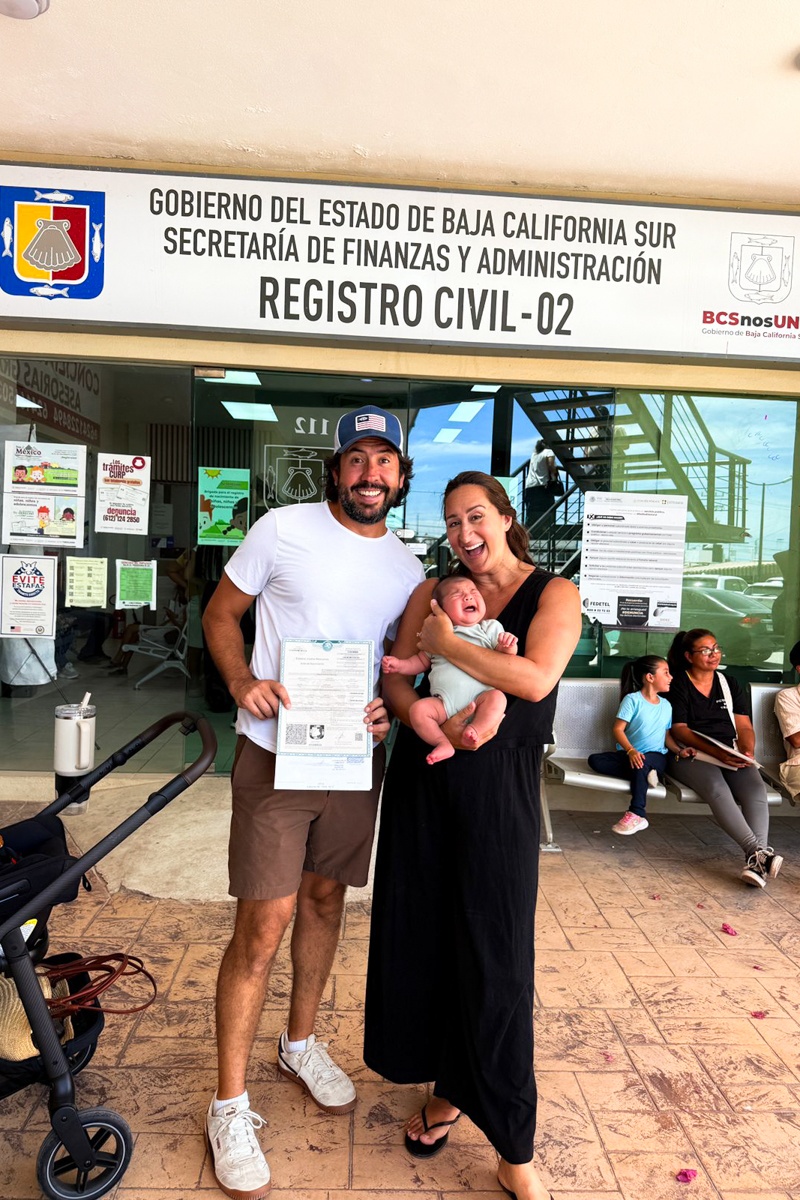
After she was born, we had to schedule an appointment at the Registro Civil (Mexico's Civil Registry Office) in Cabo San Lucas to officially register her birth and receive her Mexican birth certificate. Unlike in the United States, where the process often feels automatic, registering a baby born in Mexico required a little more planning and paperwork than I expected.
For our appointment, we brought the hospital birth documentation, our marriage certificate, passports, birth certificates, proof of residency, and a utility bill. Because we're an international family, some of our documents also had to be apostilled (an official certification that allows documents to be recognized internationally) and officially translated into Spanish before they would be accepted.
The appointment itself was quick. The most time-consuming part was making sure all of our paperwork was prepared correctly beforehand.
Step 2: Book the Appointment
CRBA appointments are requested through the MyTravelGov portal once you have an account.
Booking our appointment was actually much easier than I expected. Since we live in Cabo San Lucas, we chose the U.S. Consulate in Tijuana because it's the most convenient option for families living in Baja California Sur, and the entire process was done through myTravelGov (the U.S. Department of State's online portal for Consular Report of Birth Abroad (CRBA) applications).
After submitting our DS-2029 (the application for a Consular Report of Birth Abroad) through myTravelGov, we were able to book an appointment about two weeks later. We spent around four hours at the consulate from start to finish, but most of that time was simply waiting to be called. The actual interview and document review were surprisingly straightforward, and we were able to complete both our daughter's Consular Report of Birth Abroad (CRBA) and her U.S. passport application during the same appointment
Step 3: Gather the Documents (Start Early)
This was the part that felt endless. Birth certificates, translations, apostilles, proof of our marriage, evidence for the citizenship requirements, passport applications. The list felt impossible at times, but it is completely doable if you start early and stay organized.
Documents Needed for a CRBA and U.S. Passport in Mexico
Before our appointment, we uploaded all of our documents through myTravelGov (the U.S. Department of State's online portal for Consular Report of Birth Abroad (CRBA) applications). We also brought the original copies with us to our appointment at the U.S. Consulate in Tijuana.
Here's everything we brought:
- Our daughter's official Mexican birth certificate issued by the Registro Civil (Mexico's Civil Registry Office)
- Hospital birth documentation (Certificate of Live Birth/CENAVI)
- One U.S. passport photo for our daughter
- Both parents' passports
- Our marriage certificate
- Both parents' birth certificates
- My U.S. birth certificate as proof of citizenship
- Proof of my physical presence in the United States, including tax returns, W-2s, an employment verification letter, and supporting documentation
- Pregnancy records, ultrasound photos, and hospital records
- Completed DS-2029 (Application for a Consular Report of Birth Abroad) and DS-11 (Application for a U.S. Passport) submitted through myTravelGov
- Appointment confirmation
- Payment confirmation
- Multiple printed copies of every document, plus a few extras just in case
Even though our appointment went smoothly, having everything organized ahead of time made the process so much less stressful. I highly recommend creating a checklist and keeping all of your documents together in one folder before you travel to your appointment.
The document that required the most planning wasn't actually for our U.S. appointment, it was for registering our daughter's birth in Mexico. Because we're an international family, some of my husband's Colombian documents had to be apostilled (an official certification that allows documents to be recognized internationally) and officially translated into Spanish before they would be accepted by the Mexican government.
That experience taught me to start gathering paperwork much earlier than I thought I needed to. Between requesting official documents, arranging translations, and waiting on apostilles, the paperwork took far longer than any of the actual appointments. My biggest piece of advice is to start early and make multiple printed copies of everything, you'll always be glad you did.
Step 4: The Fees
At the time of our appointment, the government fees totaled $235 USD:
- CRBA: $100
- U.S. Passport: $135
We also paid approximately $100 USD for DHL shipping to receive our documents in Cabo San Lucas. Always verify the latest fees before your appointment since they can change.
Payment was made at the U.S. Consulate during our appointment after our documents were reviewed. My advice is to double-check the current accepted payment methods before your appointment, as they can change over time, but the payment process itself was simple and only took a few minutes
Step 5: The Appointment Itself
Our appointment was scheduled for 8:20 a.m., but we arrived around 7:40 a.m. to give ourselves plenty of time. Once we arrived, we joined the line for U.S. citizens, checked in and went through security. This is where they wil review all of your documents and make sure you have everything you need. If you don't have something, they will tell you what you need and where to go to get it, and then will let you come back in line to keep your appointment. Before entering the consulate, all of our electronics were collected, so just be prepared to be without your phone for a few hours.
The entire process took longer than I expected, but in the big picture, it really wasn't that bad. We were there from 7:40 until about 12:00pm / noon. We first submitted all of our documents for review, paid the CRBA fee, then received a number and waited to be called for our interview. One thing that surprised me was how many other families were there doing the exact same thing. For some reason, I pictured us being one of only a handful of people there... but apparently there are a lot of babies out there collecting passports!
When we were finally called, the interview itself was very relaxed. We were asked how we met, why we live in Mexico, how long we'd been living abroad, what our future plans were, and a few questions about my pregnancy and our daughter's birth. The consular officers were professional, kind, and patient throughout the entire process. We even ran into a couple of minor paperwork issues, and instead of turning us away, they worked with us to get everything corrected so we could finish everything that same day.
Looking back, the biggest thing I'd do differently is simply go in expecting to spend most of the morning there. Bring anything you and your baby might need for four or five hours; extra diapers, bottles or snacks, a change of clothes, and a little patience. The process itself was much less intimidating than I expected, and by the time we walked out, it felt like a huge milestone in bringing our daughter home on paper as well as in our hearts.
Step 6: What Arrives, and When
Before leaving the consulate after your interview, you'll be directed to the DHL shipping counter to arrange delivery of your documents. This is where you'll pay the shipping fee. For us, it was around $100 USD, but the cost depends on where you're shipping them.
You can choose to have your documents sent to either Mexico or the United States. Since my mom was planning to visit us in Cabo about a month later, we had everything shipped to her home in Las Vegas. The DHL representative told us that, in their experience, shipments to the United States typically arrive a little faster than shipments within Mexico, so that made our decision easy.
Your Consular Report of Birth Abroad (CRBA) and your child's U.S. passport are shipped separately, so you'll receive two DHL packages. Ours arrived at about the same time, roughly 18 days after our appointment. Having everything shipped meant we didn't have to make another trip back to Tijuana, which made the process even easier.
Our Timeline at a Glance
- Baby born in Cabo San Lucas: February
- Mexican birth certificate issued: April 6th
- CRBA appointment booked: April 1st
- Flight to Tijuana + appointment: April 8th - 9th
- CRBA + passport in hand: April 29th
What Made the Trip Manageable
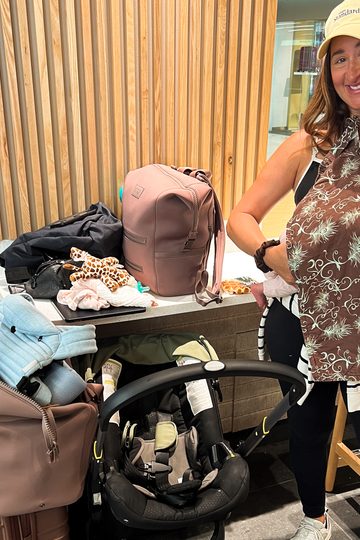
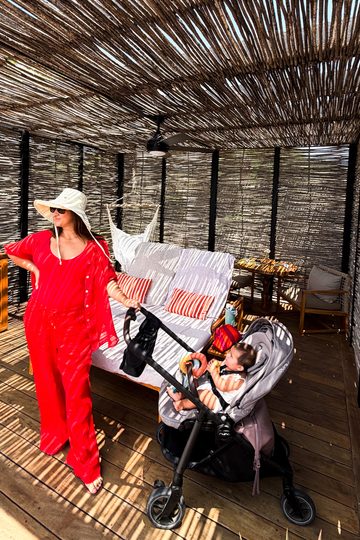
I only recommend things I would confidently tell my best friend to buy. And these items were the MVP's of our first trip
- My Doona Travel Stroller shop my baby travel essentials
- My Bumpsuit carrier shop my baby travel essentials
- Momcozy portable baby cooler and bottle warmer shop my baby travel essentials
What I'd Tell You Over Coffee
- Start gathering paperwork before your baby arrives.
- Make three copies of every document.
- Book a hotel instead of trying to fly home the same day.
- Bring extra diapers.
- Bring formula even if you don't think you'll need it.
- Expect to spend about four hours at the consulate.
- Bring snacks for yourselves.
- Don't panic if you're missing something-they may help you fix it.
FAQ
You will apply for a Consular Report of Birth Abroad (CRBA) and the passport together at a US Embassy or Consulate in Mexico, booked through the MyTravelGov portal. We did both in one appointment in Tijuana when our daughter was seven weeks old.
A baby born abroad to a qualifying US citizen parent generally acquires citizenship at birth, and the CRBA is the official document that records it. Eligibility depends on the parent's citizenship and time physically spent in the US, so review the State Department's current requirements for your situation.
Generally both parents attend the CRBA interview, and the child must be present. Check the embassy's current guidance for your specific situation, especially if one parent cannot travel.
There is no US Consulate in Cabo San Lucas, so we flew to Tijuana for our daughter's CRBA appointment. It meant a short flight and one hotel night with a newborn, and doing it as a calm overnight trip made it very manageable.
In our experience, yes. Since our daughter was born in Mexico, she became eligible for Mexican citizenship by birth, regardless of our nationality, and we were able to register her birth and receive her official Mexican birth certificate. Through my own research, I also confirmed that children born in Mexico are considered Mexican citizens by birth under Mexican law. We haven't applied for her Mexican passport yet, so I can't speak from personal experience about that process, but it's something we plan to do in the future.
Start researching while you are still pregnant. The Mexican birth certificate has to come first, appointment availability varies, and gathering documents like translations and apostilles takes longer than you would expect with a newborn in the house.
Related
Looking for more posts like this? Try these:

Other stuff you need to know
Nobody warned me about the paperwork, so consider this your warning and your reassurance. Walking out of that consulate knowing our daughter could move freely between her two countries was worth every form. This guide is part of our having-a-baby-in-Mexico series, alongside the full cost breakdown, postpartum abroad, and flying with a newborn.